The best time management technique is the one that fixes your biggest problem. If you don’t know what to work on, use a planning or prioritization method. If your days vanish into meetings and interruptions, use a scheduling method. If you can’t concentrate once you start, use a focus method. Most people end up combining one from each group.
This guide groups 15 popular time management techniques by the problem they solve, compares them in one table by best use, effort and ADHD-friendliness, and shows how to combine them into a simple system.
How to choose a time management technique
Before picking a method, name the problem. Ask yourself which of these sounds most like you:
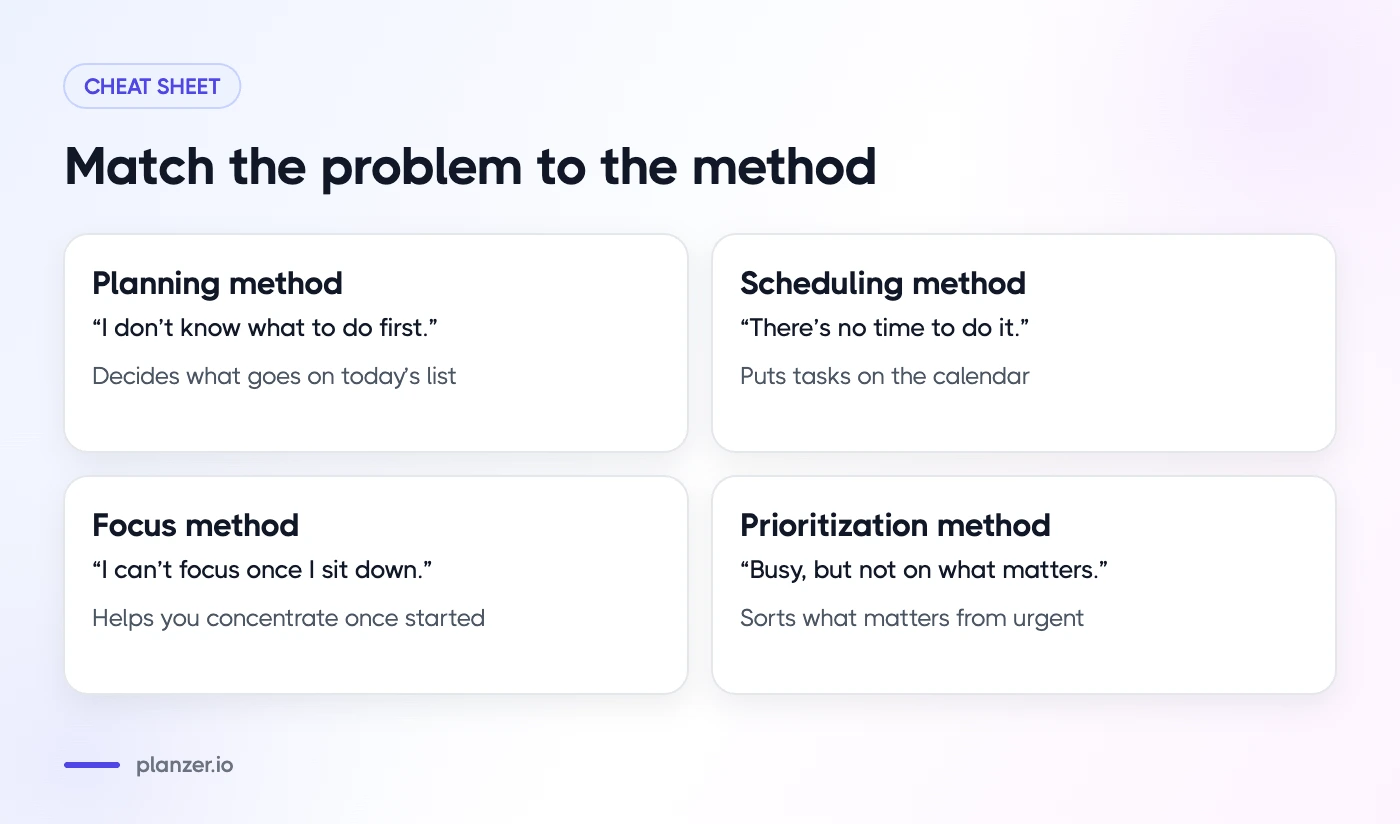
- “I don’t know what to do first.” You need a planning or prioritization method.
- “I know what to do, but there’s no time to do it.” You need a scheduling method.
- “I sit down to work and can’t focus.” You need a focus method.
- “I’m always busy but never on the important things.” You need a prioritization method, and probably a look at where your time actually goes.
A few more tips:
- Start with one. Trying five methods at once is a recipe for abandoning all of them.
- Give it two weeks. Most methods feel awkward for the first few days.
- Keep what works, drop what doesn’t. Methods are tools, not identities.
It also helps to think about the basics behind any method. Our post on why the 4 P’s of time management matter covers prioritizing, planning, productivity and positivity, which underpin every technique below.
Planning methods
Planning methods help you decide what goes on today’s list, and what doesn’t.
1. The Ivy Lee method
At the end of each day, write down the six most important tasks for tomorrow, in order. Work through them one by one, and carry over anything unfinished. It’s simple, takes five minutes and removes the morning “what now?” moment. Read our full guide to the Ivy Lee method.
2. The 1-3-5 rule
Plan one big task, three medium tasks and five small tasks each day. The mix of sizes reflects how real workdays look. Its weak spot is that nine tasks can easily overflow your hours, so check your estimates. See our guide to the 1-3-5 rule.
3. Eat the frog
Do your hardest, most important task first thing in the morning, before anything else. The idea was popularized by Brian Tracy’s book Eat That Frog!. It works well if you have the most energy early and tend to put off big tasks.
4. Getting Things Done (GTD)
David Allen’s system for capturing everything into trusted lists, clarifying the next action for each item, and reviewing weekly. It’s thorough and great for people juggling many commitments, but it takes real effort to set up and maintain.
Scheduling methods
Scheduling methods give your tasks a place on the calendar, so you can see what fits.
5. Time blocking
Assign every task, or group of tasks, to a block of time on your calendar. It makes your plan visible and shows instantly when you’ve overcommitted. Our complete guide to time blocking walks through it with examples.
6. Timeboxing
Give a task a fixed amount of time and stop when time runs out, whether or not it’s finished. Where time blocking reserves time, timeboxing caps it. It’s especially useful for perfectionists and open-ended tasks like research.
7. Day theming
Give each day (or half-day) a theme, such as Monday for planning, Tuesday for client work and Friday for admin. It cuts down on context switching and suits people who wear several hats, like founders and freelancers.
8. Task batching
Group similar small tasks and do them together: all emails at 11:00 and 16:00, all calls in one afternoon. Batching reduces the cost of switching between different kinds of work.
Focus methods
Focus methods help you concentrate once you’ve started.
9. The Pomodoro Technique
Work for 25 minutes, take a short break, and take a longer break after four rounds. It’s brilliant for starting tasks you’re avoiding and for keeping energy steady. Read our full guide to the Pomodoro Technique.
10. Flowtime
Work until your focus naturally fades, then take a break sized to the session. It’s Pomodoro without the fixed interval, which suits deep and creative work. See our guide to the flowtime technique.
11. Deep work
Cal Newport’s idea of scheduling long, distraction-free sessions for cognitively demanding work, and treating them as a priority rather than a leftover. It overlaps with time blocking but focuses on protecting your most valuable hours. Newport writes about it at calnewport.com.
12. The two-minute rule
If a task takes less than two minutes, do it now instead of writing it down. It comes from GTD and keeps tiny tasks from cluttering your list. Use it carefully: a hundred two-minute tasks can eat a morning.
Prioritization methods
Prioritization methods help you sort what matters from what merely feels urgent.
13. The Eisenhower matrix
Sort tasks into four boxes by urgency and importance: do first, schedule, delegate, drop. It’s fast and visual, and good for days when everything feels urgent. Try our free Eisenhower matrix tool, or read more about it in the Wikipedia article on time management.
14. The 80/20 rule (Pareto principle)
The Pareto principle suggests that a small share of your efforts produces most of the results. Applied to time management, it means finding the few tasks that matter most and protecting time for them.
15. The ABC method
Label each task A (must do), B (should do) or C (nice to do), then work through the A’s first. You can split further, such as A1, A2, A3. It’s a quick way to add order to a long list without drawing a matrix.
Comparison table
Use this table to compare the 15 techniques at a glance. “Effort” means how much setup and upkeep the method needs. “ADHD-friendly” is a general guide; everyone’s different.
| Technique | Type | Best for | Effort | ADHD-friendly |
|---|---|---|---|---|
| Ivy Lee | Planning | Removing morning decisions | Low | High |
| 1-3-5 rule | Planning | Realistic daily lists | Low | High |
| Eat the frog | Planning | Beating procrastination on big tasks | Low | Medium |
| GTD | Planning | Many commitments and projects | High | Low to medium |
| Time blocking | Scheduling | Seeing what fits in a day | Medium | High with flexibility |
| Timeboxing | Scheduling | Perfectionism and open-ended tasks | Low | High |
| Day theming | Scheduling | Multiple roles or clients | Medium | Medium |
| Task batching | Scheduling | Email, calls and admin | Low | Medium |
| Pomodoro | Focus | Starting and steady energy | Low | High |
| Flowtime | Focus | Deep or creative work | Low | Medium to high |
| Deep work | Focus | Protecting demanding work | Medium | Medium |
| Two-minute rule | Focus | Clearing tiny tasks | Low | Medium |
| Eisenhower matrix | Prioritization | When everything feels urgent | Low | High |
| 80/20 rule | Prioritization | Finding high-impact work | Low | Medium |
| ABC method | Prioritization | Ordering a long list | Low | Medium |
Which method suits you?
| If you… | Start with |
|---|---|
| Freeze when choosing what to do | Ivy Lee or 1-3-5 |
| Lose your days to meetings | Time blocking |
| Avoid starting hard tasks | Pomodoro or eat the frog |
| Lose focus when interrupted | Flowtime or deep work |
| Feel like everything is urgent | Eisenhower matrix |
| Work across several roles | Day theming |
| Are a perfectionist | Timeboxing |
How to combine methods
Methods work best in layers. A simple, sturdy combination looks like this:
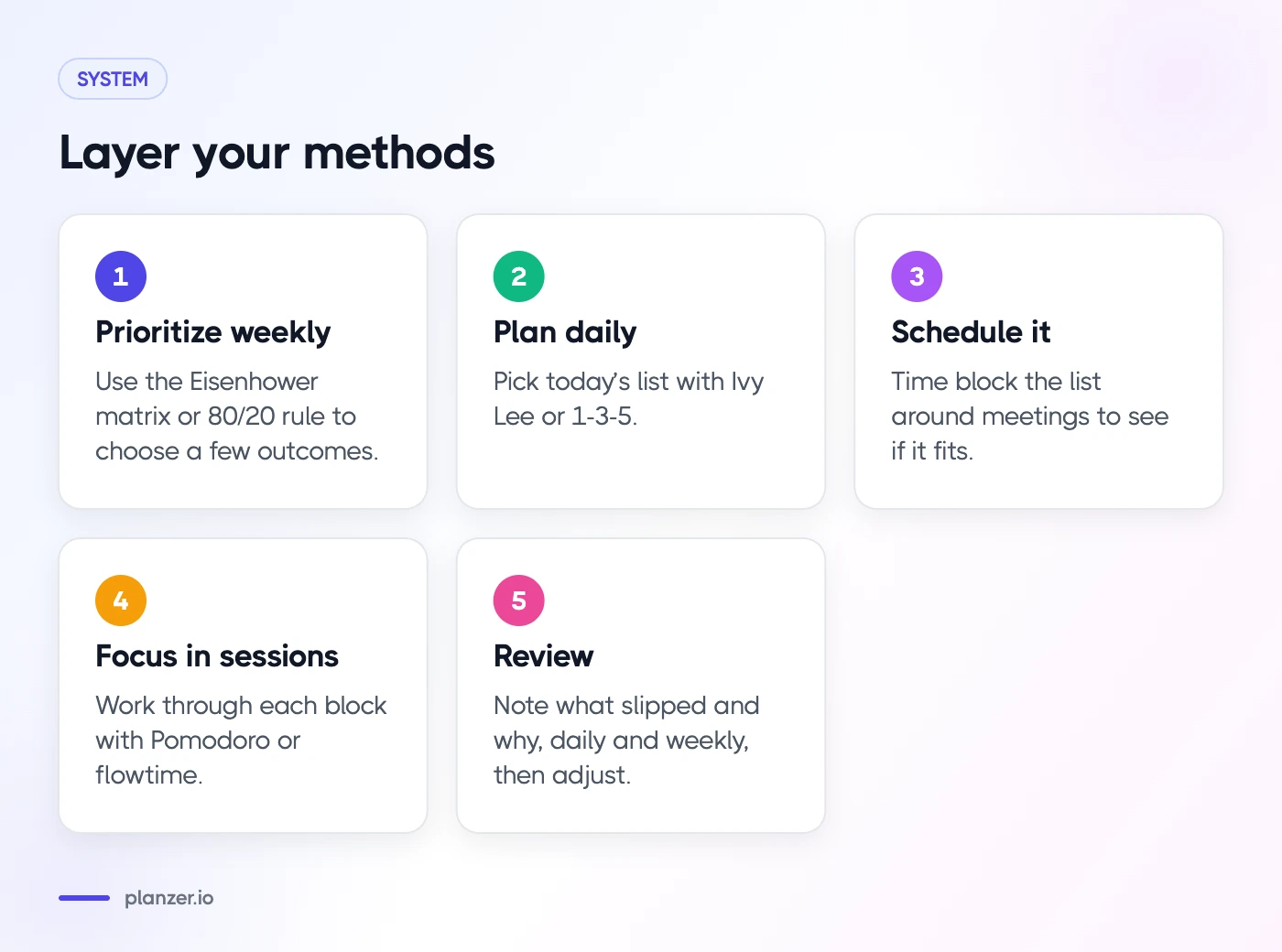
- Prioritize weekly. On Friday or Monday, use the Eisenhower matrix or the 80/20 rule to choose your few important outcomes for the week.
- Plan daily. Each morning or evening, pick today’s list with Ivy Lee or 1-3-5.
- Schedule it. Time block the list around your meetings, so you can see whether it fits.
- Focus in sessions. Work through each block with Pomodoro or flowtime.
- Review. At the end of the day, note what slipped and why. At the end of the week, look at your patterns and adjust.
If you’re not sure where your time goes in the first place, start with a time audit. A week of honest tracking makes it much easier to choose the right method.
Common mistakes
- Collecting methods instead of using one. Pick one and stick with it for two weeks.
- Ignoring estimates. Every planning method fails if the plan doesn’t fit your hours.
- No review. Without a quick look back, you repeat the same problems.
- Too rigid. If a method stops working on bad days, scale it down rather than dropping it.
How to do this in Planzer.io
Planzer.io is a daily planner, so it supports several of these techniques in one place without asking you to adopt all of them:
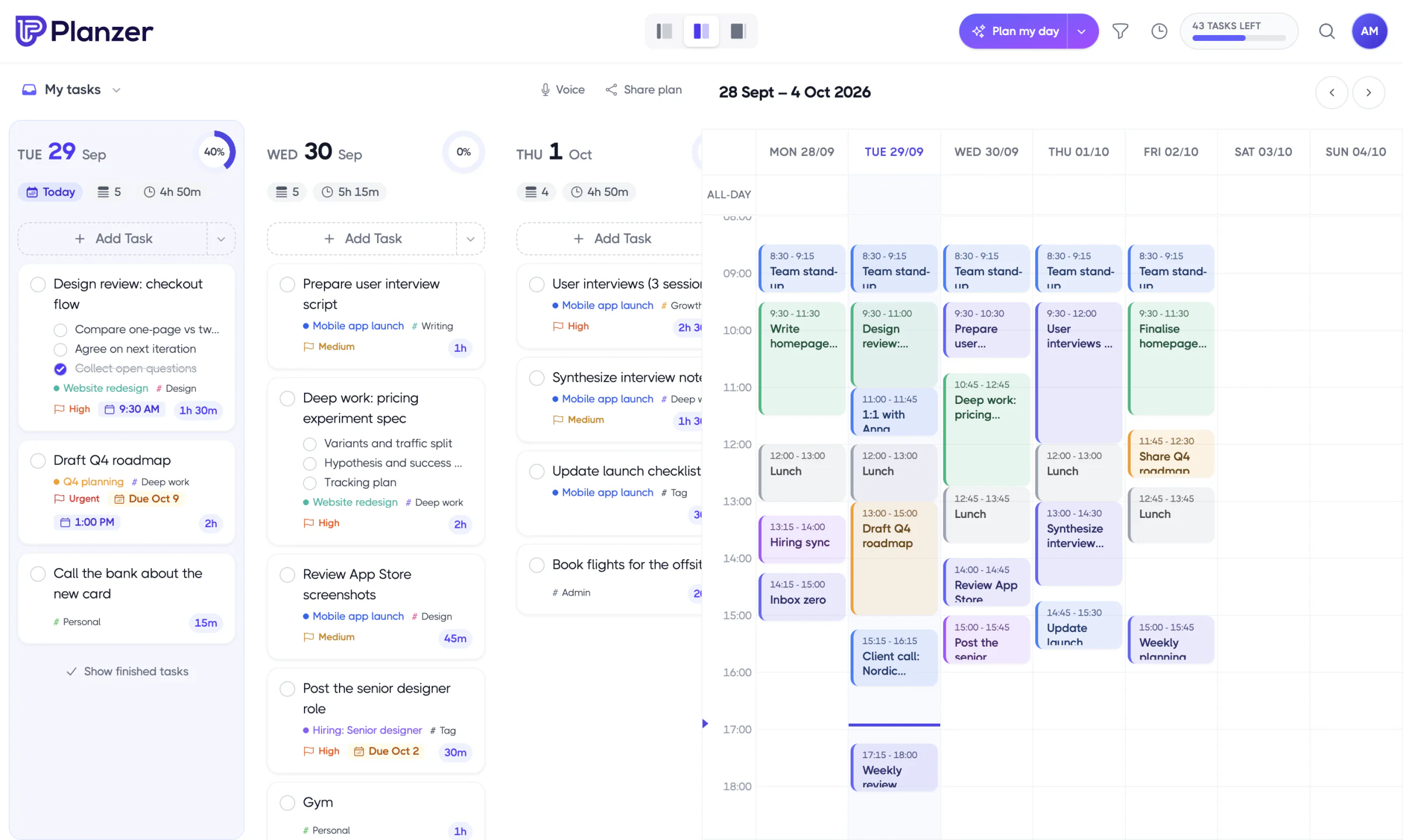
- Planning: “Plan my day” guides you through choosing today’s tasks and scheduling them; “Plan my week” and “Review my week” cover the weekly layer.
- Scheduling: drag tasks onto Google Calendar, Outlook Calendar or iCloud Calendar to time block them. The running order shows when you’d finish if you work down the list.
- Focus: focus sessions of 15, 25, 45 or 60 minutes that can run into overtime work for both Pomodoro and flowtime.
- Prioritization and review: priorities, tags and saved filters help you sort tasks, and analytics show “Estimated vs actual” and “Why tasks slip.”
FAQ
What is the most effective time management technique?
There isn’t one that works for everyone. Time blocking is a strong all-rounder because it makes your plan visible and shows when you’re overcommitted. Pair it with a simple prioritization method and a focus method, and you’ll cover most problems.
What are the 4 P’s of time management?
In our article on the topic, the 4 P’s are prioritizing, planning, productivity and positivity. Different sources use slightly different lists, but they all point to the same idea: decide what matters, plan it, do it, and look after your energy.
Which time management methods work for ADHD?
Methods with short lists, visible time and quick starts tend to work well: Ivy Lee, 1-3-5, timeboxing, Pomodoro and flexible time blocking. Methods with heavy setup, like full GTD, can be harder to sustain. Whatever you pick, keep it simple and forgiving.
How many techniques should I use at once?
Start with one, and add a second only once the first feels natural. Most people settle on two or three: one for planning or prioritizing, one for scheduling and one for focus.