The 1-3-5 rule is a way to plan a realistic day: you choose one big task, three medium tasks and five small tasks, and nothing else goes on today’s list. It forces you to decide what matters before the day starts, instead of carrying a list of thirty items you were never going to finish.
It works best with one extra check: make sure those nine tasks actually fit the hours you have. This guide covers what the 1-3-5 rule is, where it comes from, how to pick each task, how to check it against your time, and how to adapt it when your calendar is full of meetings. There’s a copy-and-paste template at the end.
What the 1-3-5 rule is
The rule gives your day a fixed shape:
- 1 big task. The one thing that would make today a success. It usually takes a couple of hours or more and needs focus.
- 3 medium tasks. Meaningful work that takes roughly 30–60 minutes each.
- 5 small tasks. Quick jobs that take 15 minutes or less: a reply, a booking, a short review.
That’s nine tasks in total. The limit is the point. When your list has a fixed number of slots, adding something means removing something else, so every addition becomes a conscious trade-off.
Where it comes from
The 1-3-5 rule was popularized by the career site The Muse in an article titled A Better To-Do List: The 1-3-5 Rule. The idea took off because it solves a common problem with to-do lists: they have no natural limit. A list can grow forever, while a day can’t.
It sits in the same family as other short-list methods, like the Ivy Lee method, which limits you to six tasks in priority order. The 1-3-5 rule adds a twist by mixing task sizes, which matches the way real workdays look: a bit of deep work, some medium projects and a scatter of small admin.
How to pick your 1, 3 and 5
Plan your 1-3-5 list at the end of the previous day or first thing in the morning. Here’s a simple process.
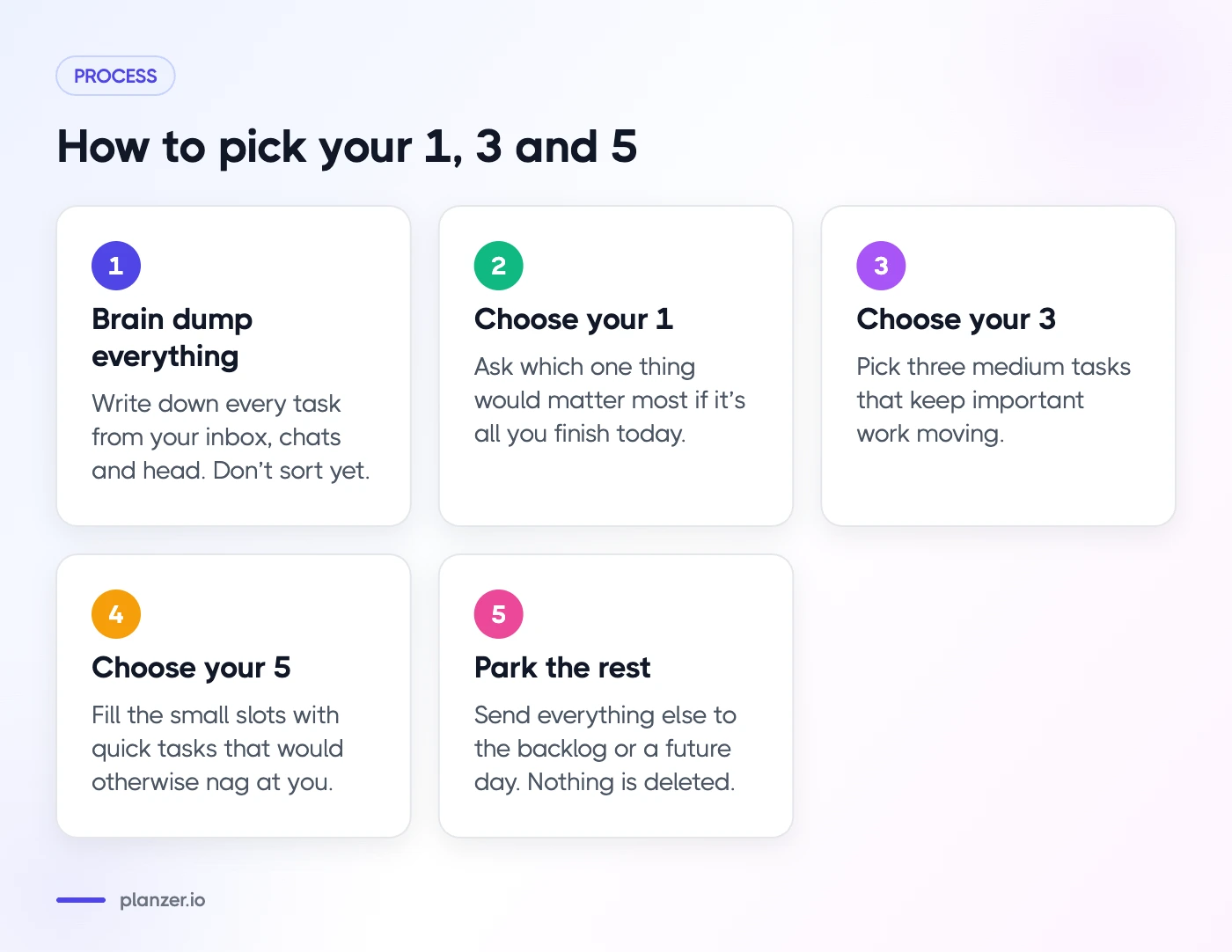
Step 1: Brain dump everything
Write down every task on your mind, from your inbox, chat tools, project boards and head. Don’t sort yet. If you already keep a master list, start from there; our guide to task management explains how to keep one tidy.
Step 2: Choose your 1
Ask: “If I only finish one thing today, which one would matter most?” Good candidates move a key project forward, unblock other people or have a deadline coming up. If two tasks compete, use the Eisenhower matrix to separate the important from the merely urgent.
Step 3: Choose your 3
Pick three medium tasks that support your goals or keep important work moving. These are often steps in larger projects: draft a section, prepare a presentation, review a proposal.
Step 4: Choose your 5
Fill the small slots with quick tasks that would otherwise nag at you. Batch them where you can, for example all five between two meetings or at the end of the day.
Step 5: Park the rest
Everything else goes back to your backlog or to a specific future day. It isn’t deleted; it’s just not today’s job. This is the hardest step and the most useful one.
What counts as big, medium and small?
| Size | Typical time | Examples |
|---|---|---|
| Big (1) | 2–4 hours | Write a report, build a feature, prepare a pitch, study a full chapter |
| Medium (3) | 30–60 minutes | Draft a proposal outline, review a pull request, plan next week’s content |
| Small (5) | 5–15 minutes | Reply to a client, book a meeting room, pay an invoice, update a ticket |
These ranges are guides, not rules. What matters is the relative size, and that the total adds up to a day you can actually finish.
Make sure it fits your hours
Here’s where a lot of 1-3-5 lists go wrong. Nine tasks sounds modest, but the sizes add up fast. Using the middle of the ranges above:
- 1 big task at 3 hours = 3 hours
- 3 medium tasks at 45 minutes = 2 hours 15 minutes
- 5 small tasks at 10 minutes = 50 minutes
That’s just over six hours of focused work, before meetings, breaks, lunch, email and interruptions. On a day with three hours of meetings, it won’t fit.
So add one step to the classic method:
- Estimate every task. Write a time next to each of the nine.
- Add up the total. Compare it with the free time on your calendar today.
- Check your finish time. If you start at 9:00 and work down the list, when would you finish? If the answer is later than you plan to stop, the list is too long.
- Cut from the bottom. Drop a small task first, then a medium one. Protect the big one.
If you consistently finish early, you can make your estimates tighter. If you consistently overrun, your estimates are probably optimistic, which is very common. Track how long tasks really take for a week and adjust.
Adapting 1-3-5 for meeting-heavy days
On days full of meetings, the classic 1-3-5 is too much. Scale it down rather than abandoning it:
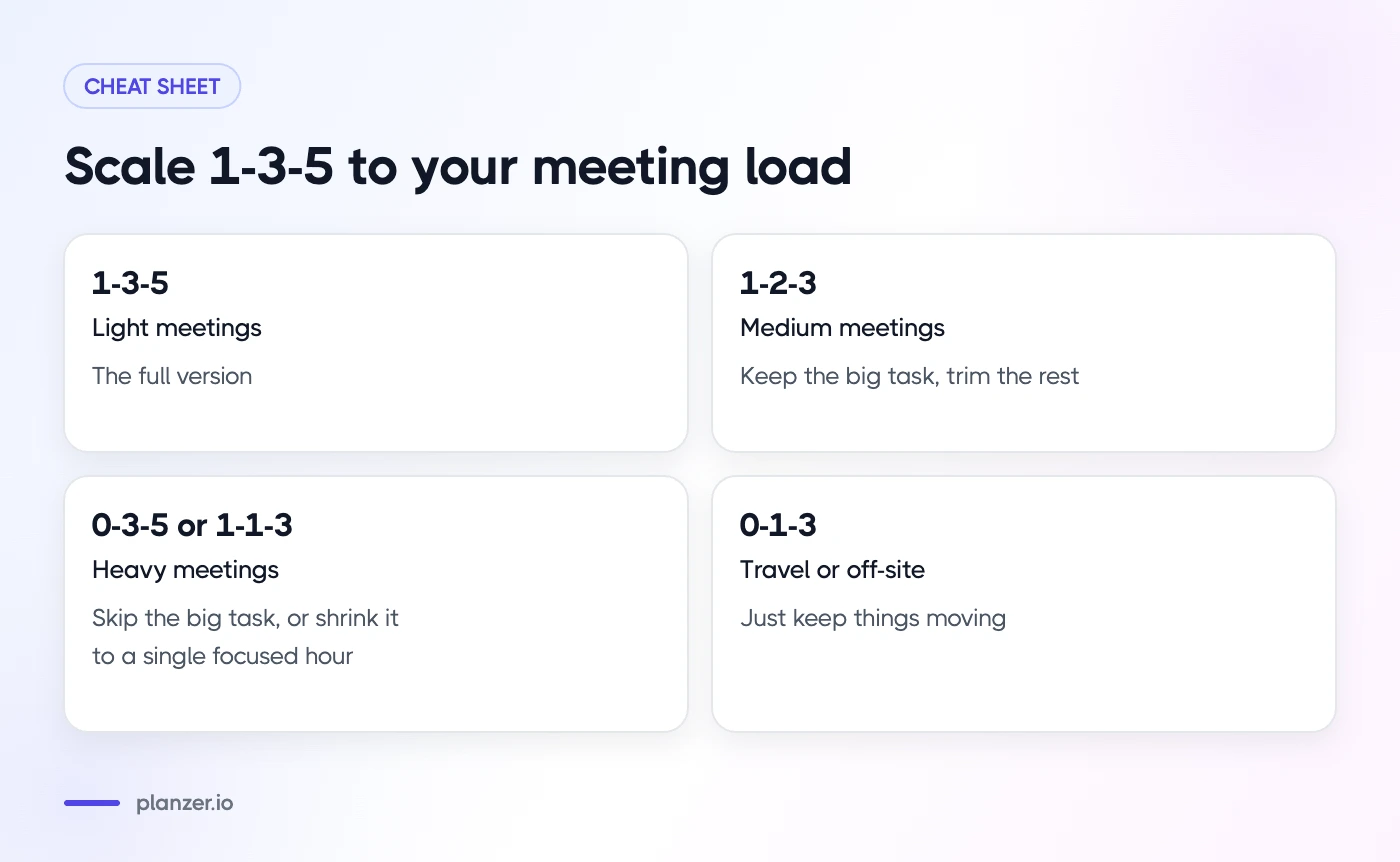
| Day type | Shape | Notes |
|---|---|---|
| Light meetings | 1-3-5 | The full version |
| Medium meetings | 1-2-3 | Keep the big task, trim the rest |
| Heavy meetings | 0-3-5 or 1-1-3 | Either skip the big task or shrink it to a single focused hour |
| Travel or off-site | 0-1-3 | Just keep things moving |
You can also count meetings as part of your plan. A long workshop can be your “1.” A one-hour stakeholder call can count as one of your “3.” What matters is that the total load is honest. For more on working around a crowded calendar, read our guide to planning your day around meetings.
When the day changes
If something urgent lands mid-morning, don’t just add it. Swap it: decide which of your nine tasks moves to tomorrow. The list stays at nine, and you stay honest about what’s possible.
1-3-5 template
Copy this into your notes app or planner each morning, or use our free daily planner template as a base.
- Date: …
- Free hours today (after meetings): …
- The 1 (big): … (estimate: …)
- The 3 (medium): 1) … (…) 2) … (…) 3) … (…)
- The 5 (small): 1) … 2) … 3) … 4) … 5) …
- Total estimate: …
- Expected finish time: …
- Parked for later: …
- End-of-day note: what moved and why: …
The last line is useful over time. If the big task keeps slipping for the same reason, like interruptions or a vague first step, you can fix the cause.
How to do this in Planzer.io
You don’t need special software for the 1-3-5 rule, but a few features in Planzer.io make the “does it fit?” check automatic:
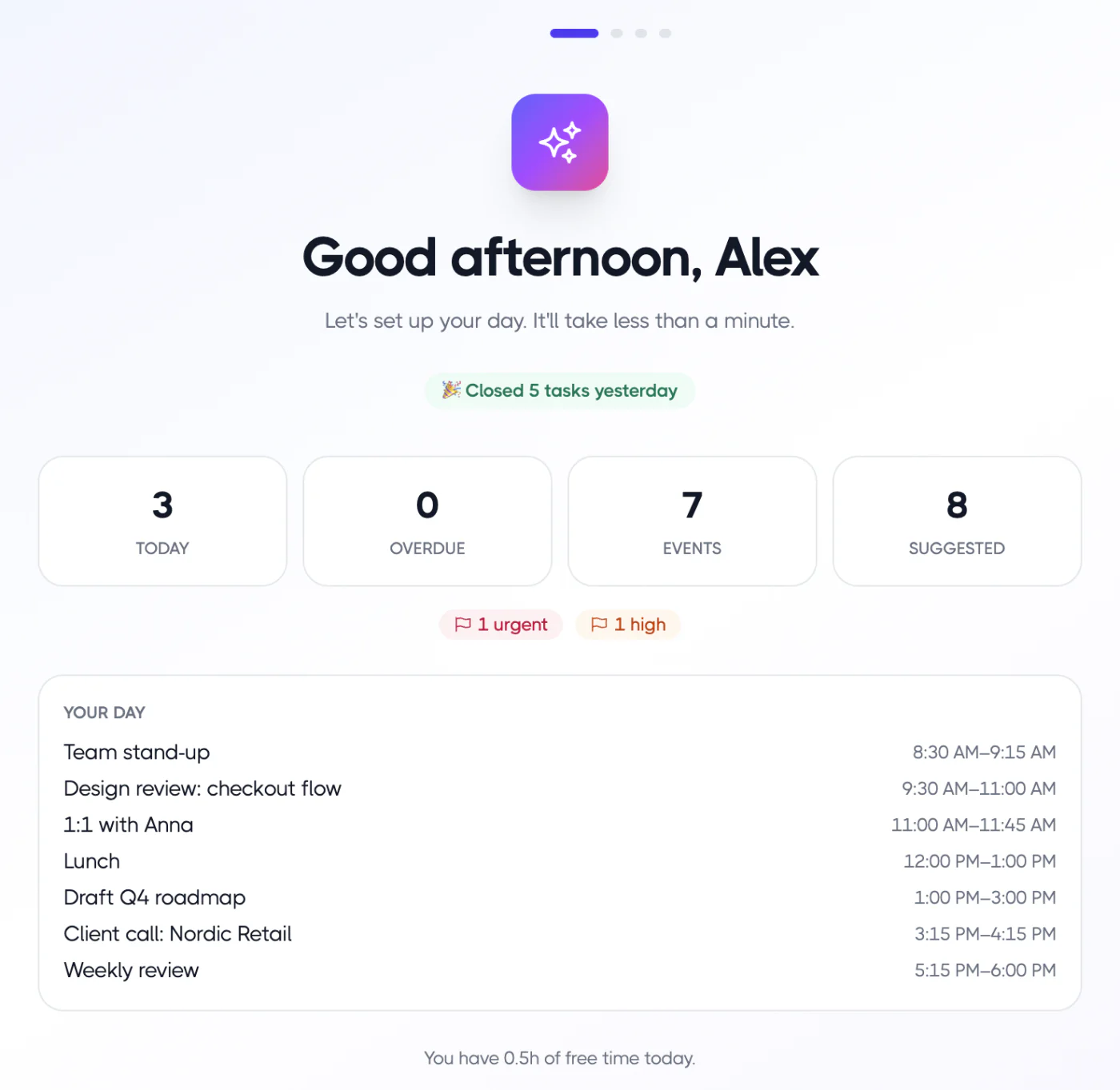
- Plan my day walks you through picking tasks from overdue and backlog items and scheduling them, so you can pick your 1, 3 and 5 in one sitting.
- Estimates with quick add: type “Review proposal ~45m !high” and the estimate and priority are is saved with the task.
- Running order shows a start and end time for each task if you work down the list, working around meetings, plus a “Done around …” time that turns amber if your list runs past your shutdown time. That’s the 1-3-5 time check, done for you.
- Priorities let you mark the big task as high so it stays at the top.
If you want to dig deeper into daily planning as a habit, our daily planning page explains how Planzer.io approaches it.
FAQ
Is 9 tasks a day too many?
It depends on their size and your free time. Nine tasks of mixed size can be a full but realistic day if you have around six hours of focused time. On busy days, scale down to 1-2-3 or fewer. Always check your estimates against the hours you have.
What counts as a big task?
A big task is the one with the most impact that needs sustained focus, usually two hours or more. If a task would take a whole week, it’s a project, not a task; break it down and make one chunk of it today’s big task.
Does the 1-3-5 rule work for students?
Yes. A study day might have one big task (a practice exam or essay section), three medium tasks (reading a chapter, reviewing notes, a problem set) and five small ones (emailing a tutor, printing notes, booking a library room). Fit it around lectures the same way you’d fit work around meetings.
What if I finish my 1-3-5 early?
Enjoy it, or pull the next most important task from your backlog. Finishing early is a sign your estimates are realistic. Just don’t start the next day with a longer list to compensate.