The Ivy Lee method is simple: at the end of each workday, write down the six most important things to do tomorrow, rank them, and the next day work on them one at a time, in order. Anything unfinished moves to the next day’s list. That’s the whole method, and it has survived for more than a hundred years because it forces you to prioritize and then focus.
Below you’ll find the story behind it, the five rules, why it works, how to pair it with an end-of-day routine, and a template you can copy.
The story behind the Ivy Lee method
Ivy Lee was an early 20th-century American consultant, best known today as a pioneer of public relations. The story goes that in 1918 Charles M. Schwab, president of Bethlehem Steel, asked Lee how his team could get more done. Lee asked for 15 minutes with each executive and said Schwab could pay him whatever he thought the advice was worth after three months.
The advice was the six-task list. According to the story, Schwab was so pleased with the results that he sent Lee a check for $25,000, a large sum at the time. You can read more on Ivy Lee’s Wikipedia page and in James Clear’s write-up of the method, which helped make it popular again.
Whether every detail of the story is accurate matters less than the fact that the method is easy to test. Try it for two weeks and see what happens.
The method in five rules
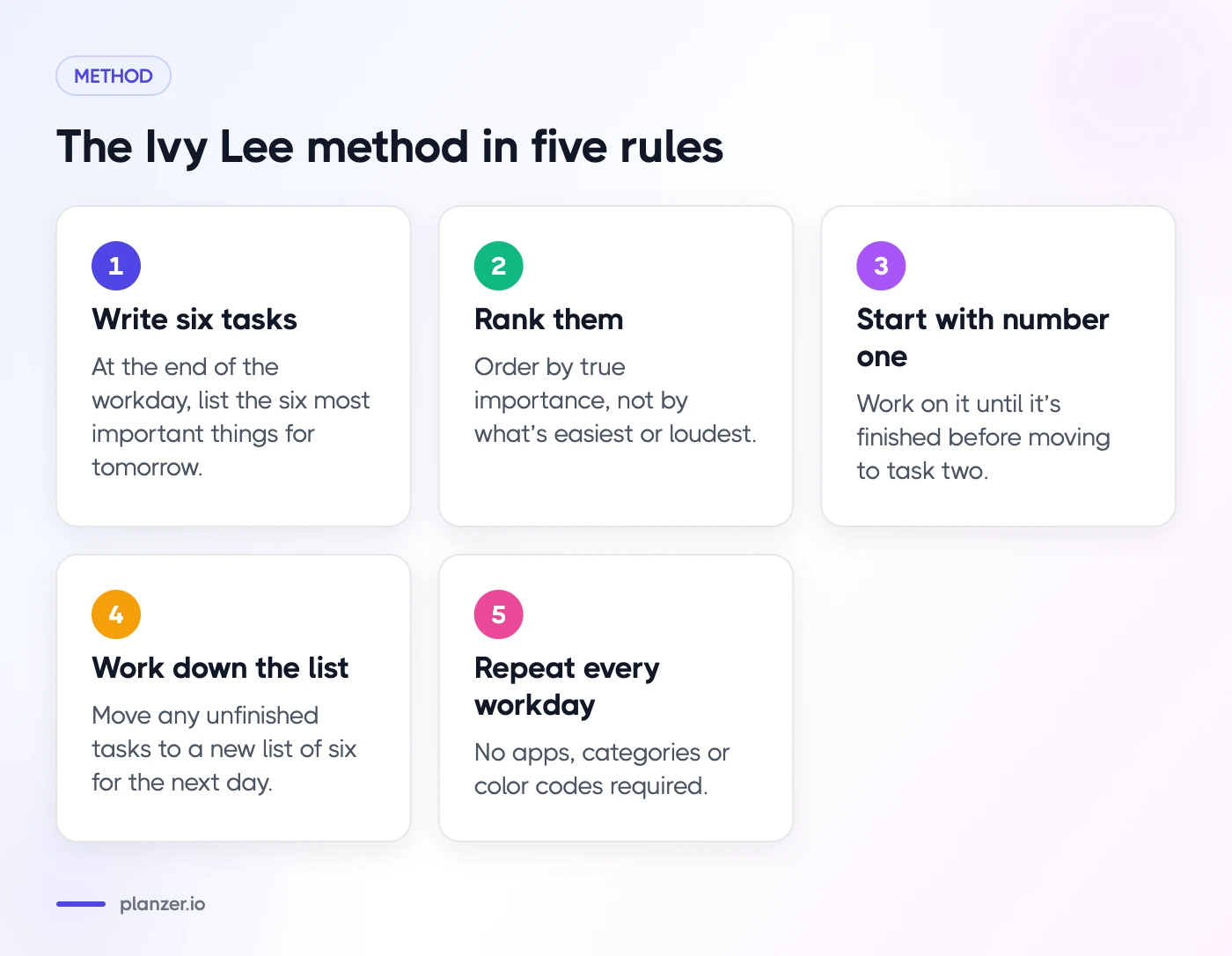
- At the end of each workday, write down the six most important things to do tomorrow. No more than six.
- Rank them by true importance. Number one is the task that matters most, not the one that’s easiest or loudest.
- Tomorrow, start with task one and work on it until it’s finished before moving to task two.
- Work down the list the same way. At the end of the day, move any unfinished tasks to a new list of six for the following day.
- Repeat every working day.
That’s all. No apps, categories or color codes required.
An example Ivy Lee list
Here’s what a list might look like for a product manager:
- Finish the Q4 roadmap draft
- Review design specs for the onboarding flow
- Write feedback on the pricing page copy
- Prepare questions for Thursday’s customer interview
- Reply to the partnership email from last week
- Clean up the sprint board
Notice that the list mixes big and small tasks, and that it’s ranked by importance, not by size. The roadmap draft comes first even though cleaning the sprint board would be faster.
Why it works: prioritization and single-tasking
The method looks almost too simple. Here’s why it still holds up.
The limit forces real choices
Six is small enough that you can’t include everything. You have to decide what actually matters, which is the hardest and most valuable part of planning. A long to-do list lets you avoid that decision. A list of six doesn’t.
Deciding the night before removes morning friction
When you sit down in the morning, the first task is already chosen. You don’t spend 30 minutes checking email while deciding what to do. You just start.
One task at a time
Working on one task until it’s done means less switching between tasks. Every switch costs you a little time and attention to get back into the work. The Ivy Lee method builds single-tasking into the plan itself.
Carryover keeps you honest
If the same task moves forward day after day, you learn something. Maybe it’s too big and needs breaking down. Maybe it’s not really important. Either way, the list makes the pattern visible.
For a broader look at how prioritization fits into time management, see our guide to the 4 Ps of time management.
Ivy Lee + a shutdown ritual
The Ivy Lee method has a built-in timing that many people overlook: you make the list at the end of the day. That’s exactly when a shutdown routine happens, so the two fit together naturally.
Here’s a 10-minute version that combines them:
- Review today. What did you finish? What’s left from today’s six?
- Note why anything slipped. One word is enough: interrupted, underestimated, unclear.
- Write tomorrow’s six. Start with carryover, then add new items until you hit six.
- Rank them. Put the most important task first.
- Add a rough estimate to each. 30 minutes, 90 minutes, and so on.
- Check against tomorrow’s calendar. If you have five hours of meetings and twelve hours of estimated work, cut or shrink tasks now.
Step 6 is the modern upgrade. Ivy Lee’s original method assumes you can work down the list uninterrupted. Most of us have meetings in between, so it helps to know whether the list fits before the day starts.
For the full routine, see our guide to the shutdown ritual.
Ivy Lee method template
Copy this into a notebook, a notes app or a daily planner template:
Date: …
Carryover from today: …
1. … (estimate: …)
2. … (estimate: …)
3. … (estimate: …)
4. … (estimate: …)
5. … (estimate: …)
6. … (estimate: …)
Meetings tomorrow: …
Total estimate vs free time: …
Done around: …
Fill it in at the end of the day, and tomorrow, start with number one.
Running the Ivy Lee method digitally
Paper works fine. A digital version adds two things paper can’t do easily: it shows your list next to your calendar, and it can tell you when you’ll finish.
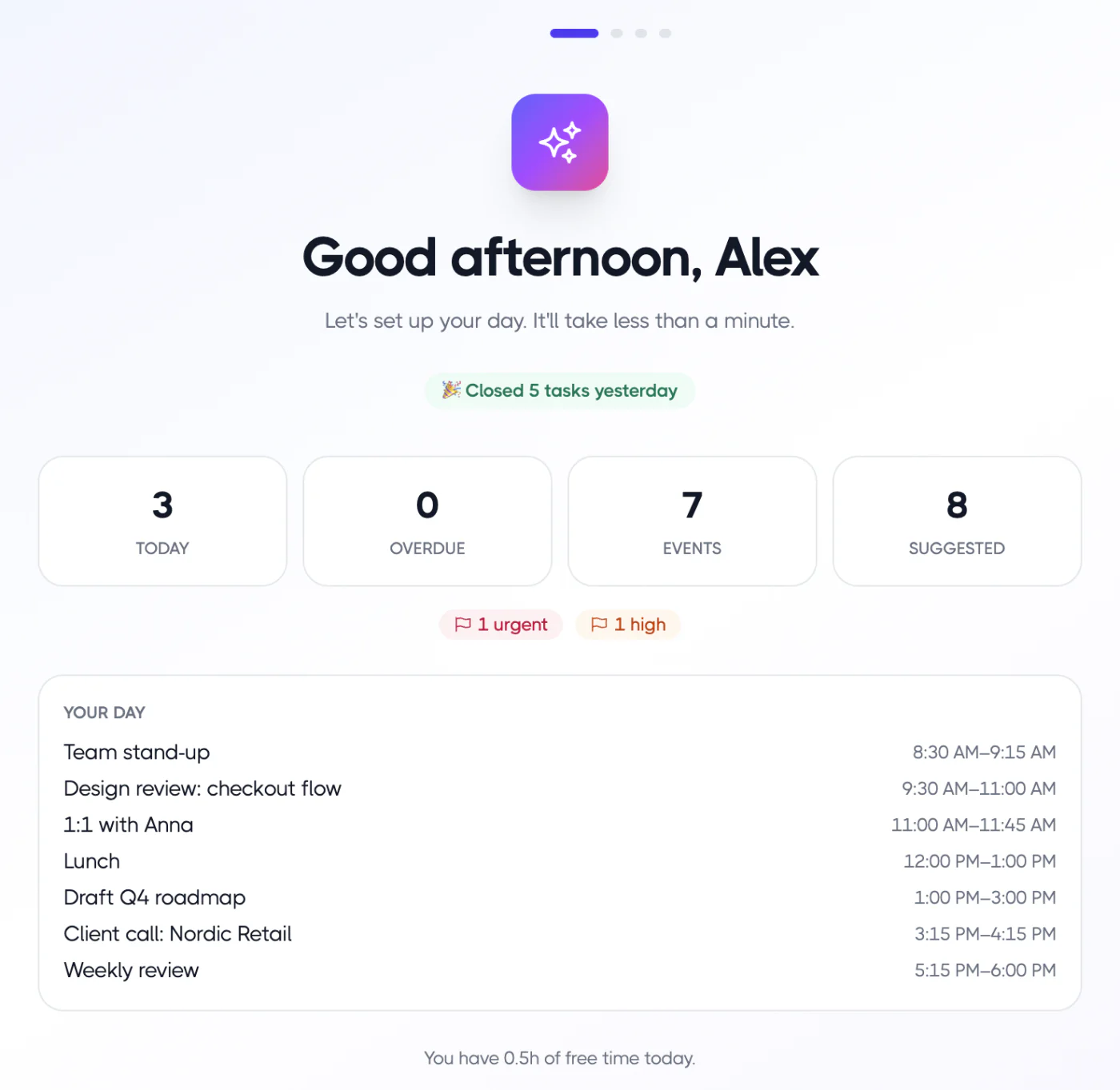
Here’s what to look for in a task management tool if you want to run Ivy Lee digitally:
- A “today” list you can reorder by drag and drop. Order is the method.
- Estimates on each task. So you know if six tasks fit in the time you have.
- Your calendar next to the list. Meetings are part of the day, whether you like it or not.
- Easy carryover. Unfinished tasks should roll to tomorrow with one click, not be retyped.
How to do this in Planzer.io
Planzer.io’s daily planning flow maps well to Ivy Lee:
- At the end of the day, use “Wind down the day” to review wins and tag why tasks slipped.
- Use “Plan my day” to pick your six. Overdue and backlog tasks are shown so carryover is easy.
- Drag them into rank order and add estimates (type ~45m in quick add).
- Today’s list shows a running order: a start and end time for each task if you work down the list, with meetings worked around, and a “Done around …” time that turns amber if the plan runs past your shutdown time.
- Start a focus session on task one and don’t move on until it’s done.
The running order is basically the Ivy Lee list with a clock attached.
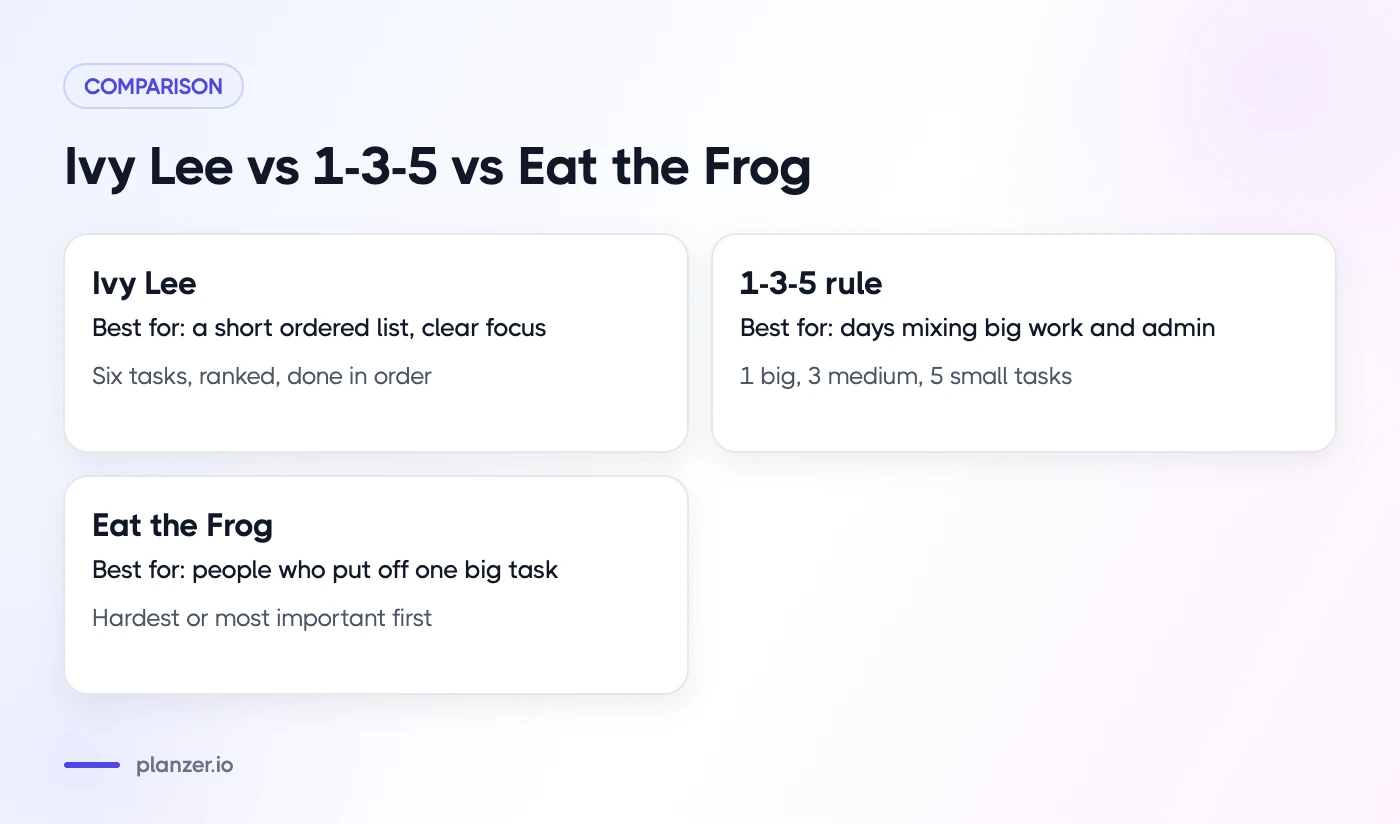
Ivy Lee vs 1-3-5 vs Eat the Frog
Ivy Lee isn’t the only simple prioritization method. Here’s how it compares to two popular ones.
| Method | How it works | Best for |
|---|---|---|
| Ivy Lee | Six tasks, ranked, done in order | People who want a short, ordered list and clear focus |
| 1-3-5 rule | One big task, three medium, five small | Days with a mix of big work and small admin |
| Eat the Frog | Do your hardest or most important task first | People who procrastinate on one big task |
They overlap more than they differ. Ivy Lee’s number one is often your “frog”. And if you find six tasks too uniform, the 1-3-5 rule adds structure by task size. Pick the one that fits how your days usually go, and stick with it for a couple of weeks before judging.
FAQ
Why six tasks?
Six is the number Ivy Lee used, and it’s small enough to force real prioritization while still covering a full day. It isn’t magic, though. If your tasks are large or your calendar is full of meetings, three or four might be more realistic. The important part is the hard limit.
What if I don’t finish all six tasks?
That’s normal and expected. Move the unfinished tasks to the top of tomorrow’s list, then add new ones until you have six. If one task keeps carrying over, break it into smaller pieces or ask whether it really belongs on the list.
Is the Ivy Lee method good for ADHD?
It can be. A short list and a fixed order reduce the number of decisions during the day, which many people with ADHD find helpful. Some people find six tasks overwhelming, so starting with three is fine. Adding estimates and a visible finish time can also help with time blindness.
Can I use the Ivy Lee method with meetings?
Yes. Work on your list in the gaps between meetings, and pick the order so your biggest task falls into your longest free slot. Checking your list against tomorrow’s calendar the night before makes this much easier.