
The best daily reflection questions are short, specific and tied to what actually happened today. Ask one or two about wins, one about time, one about energy and one about tomorrow. That takes about two minutes, and it’s enough to close the day with a clear head and start tomorrow with a plan.
Below you’ll find 30 prompts grouped by purpose, a simple routine for using them, and a few templates you can copy. You don’t need to answer all 30. Pick a handful that fit your work and rotate the rest in when you feel stuck.
Why reflect daily
A day goes by fast. By Friday, Monday is a blur, and the small lessons from each day are gone. A short end of day reflection catches those lessons while they’re still fresh: the task that took twice as long as you thought, the meeting that drained you, the hour where everything clicked.
Reflection isn’t navel-gazing. It’s a well-established habit in professions like teaching and medicine, often called reflective practice: you look at what you did, why it went the way it did, and what you’ll change next time. Applied to a workday, it does three useful things:
- It closes open loops. Writing down what’s unfinished makes it easier to stop thinking about work in the evening.
- It improves your planning. Noticing where your estimates were off is the fastest way to plan more realistic days.
- It shows you progress. On days that felt messy, listing what you did finish is a quiet reminder that you moved forward.
Daily reflection works best as the last step of a shutdown ritual, the short routine you use to end your workday on purpose instead of just closing the laptop.
How to use these prompts in 2 minutes
The biggest mistake with daily journal prompts for work is making them too heavy. If reflection takes 20 minutes, you’ll skip it by Wednesday. Keep it light:
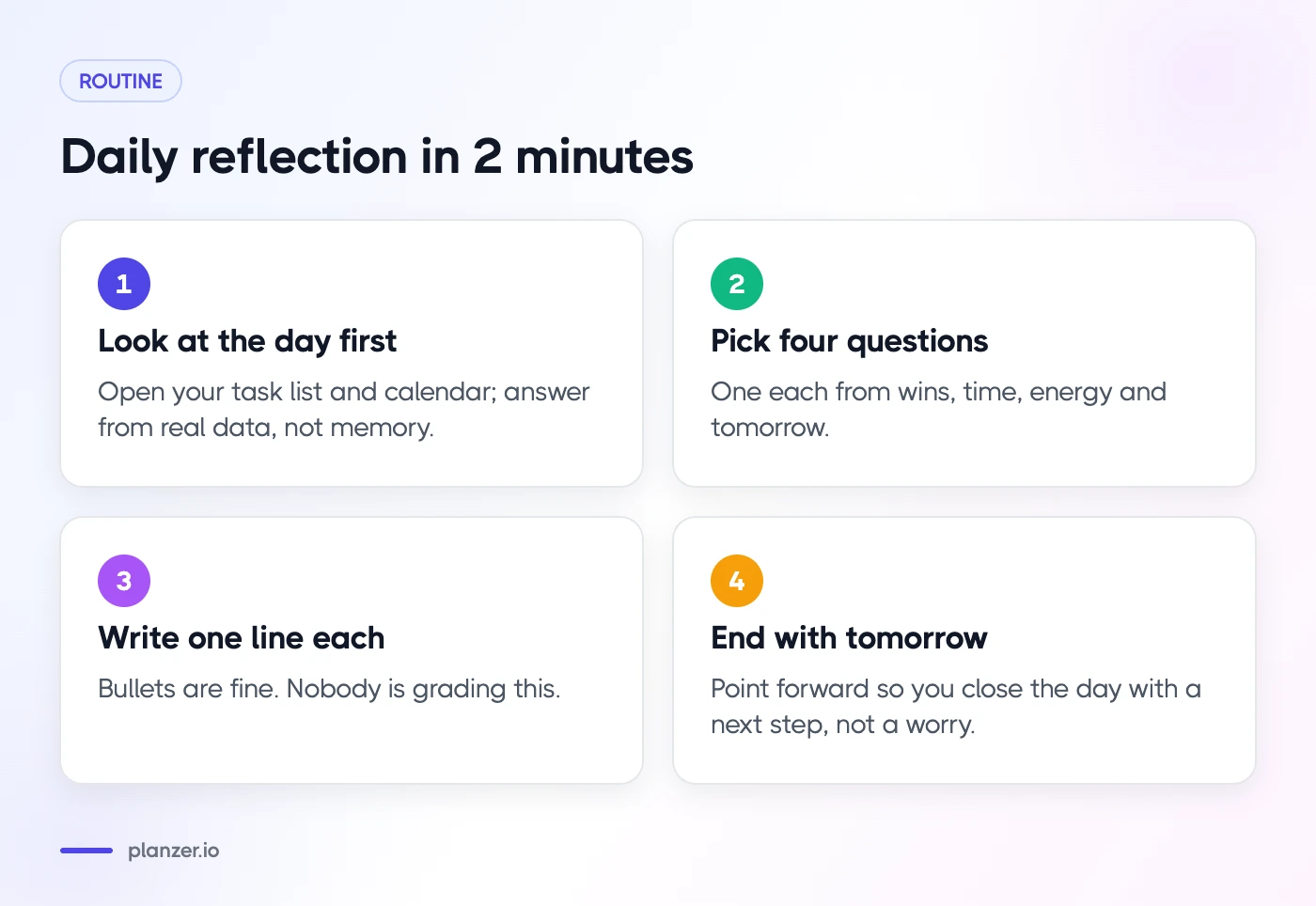
- Look at the day first. Open your task list and calendar. What did you finish? What moved? Answering from real data beats answering from memory.
- Pick four questions. One from each group below: wins, time, energy and tomorrow.
- Write one line per answer. Bullet points are fine. Nobody is grading this.
- End with tomorrow. The last question should always point forward, so you close the day with a next step rather than a worry.
Here’s a mini-template you can paste into a notes app or journal:
Today I finished: …
What took longer than expected, and why: …
Energy today (1–5): … What affected it: …
First thing tomorrow: …
That’s it. Two minutes, four lines. If you have more time or something big happened, go deeper with the extra prompts below.
Questions about wins and progress
Start with what went well. It’s easy to skip, but it sets a better tone for the rest of the reflection and makes it easier to be honest about what didn’t go well.
- What did I finish today that I’m glad is done?
- What’s one small win I’d normally overlook?
- Which task moved my most important project forward?
- What did I learn today, even if it was by accident?
- Who helped me today, and did I thank them?
- What did I do today that future me will appreciate?
- Where did I make a good decision under pressure?
- If today had a headline, what would it be?
Tip: if you can’t think of a win, look at your completed tasks. Even on chaotic days there’s usually something you closed out.
Questions about time and estimates
This is the group most people skip, and it’s the one that improves your planning the most. Comparing what you planned with what actually happened is how you get better at estimating, and how you stop building days that are impossible to finish.
- Which task took much longer than I estimated? Why?
- Which task was quicker than I thought?
- What interrupted me most today?
- How much of my day went to work I hadn’t planned?
- Did I start my most important task early enough?
- What did I plan but not get to, and was it ever realistic?
- If I replayed today, what would I cut or move?
If you keep coming back to question 9, you’re not alone. Underestimating how long things take is so common that psychologists call it the planning fallacy. The fix is less willpower and more data: write down your estimate, compare it with reality, and adjust next time.
Tag the reason when tasks slip
When a task doesn’t get done, write one word for why: interrupted, underestimated, unclear, low energy or deprioritized. After a couple of weeks, those tags tell you more than any single reflection. If most slips are unclear, you need better task definitions. If they’re interrupted, you need protected focus time.
Questions about energy and mood
Your output depends on your energy as much as your time. These questions help you notice patterns, like which kinds of work drain you and which times of day you do your best thinking.
- How was my energy today, from 1 to 5?
- When during the day did I feel most focused?
- What drained me today?
- What gave me energy?
- Did I take real breaks, or just switch screens?
- What’s one thing that’s bothering me that I can let go of tonight?
- What would make tomorrow feel a bit easier?
Rating your energy with a single number takes seconds and builds a useful record. Over time you might see that your energy dips every day you have more than three meetings, or that your best work happens before lunch. That’s information you can plan around.
Questions to set up tomorrow
End every reflection here. A clear first step for tomorrow makes it easier to switch off tonight and easier to start in the morning.
- What’s the one thing that must happen tomorrow?
- What’s my first task tomorrow morning?
- What can I drop, delegate or move to later this week?
- What meetings tomorrow need preparation?
- Is anything waiting on someone else that I should follow up on?
- What’s a realistic number of tasks for tomorrow, given my calendar?
- Where in tomorrow’s calendar is my best focus time?
- What would make tomorrow a good day?
Your answers here become the first draft of tomorrow’s plan. In the morning, you just check them against your calendar and start.
Daily reflection exercises: three quick formats
Not every day calls for the same kind of reflection. Here are three daily reflection exercises you can rotate between.
The 4-line close (2 minutes)
One question from each group, one line each. This is your default.
Start, stop, continue (3 minutes)
Write one thing to start doing, one thing to stop and one thing to continue. It’s simple and works well after a day that felt off but you can’t say why.
Plan vs reality (5 minutes)
List what you planned this morning next to what actually happened. Mark each task as done, moved or dropped, and add a one-word reason for anything that didn’t get done. This is the most useful exercise for improving estimates.
Daily vs weekly reflection
Daily and weekly reflection do different jobs, and they work best together.
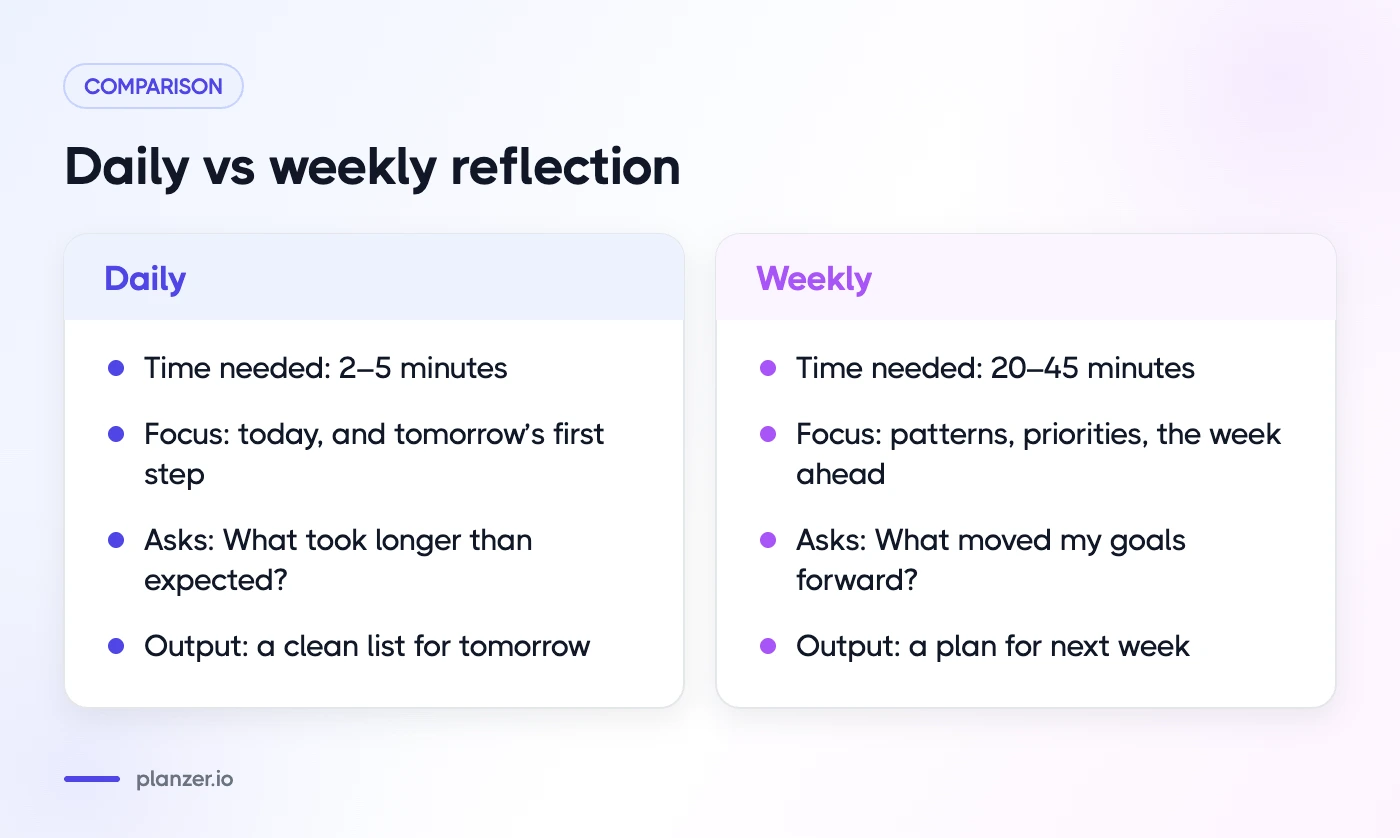
| Daily reflection | Weekly reflection | |
|---|---|---|
| Time needed | 2–5 minutes | 20–45 minutes |
| Focus | What happened today, tomorrow’s first step | Patterns, priorities, the week ahead |
| Typical questions | What took longer than expected? What’s first tomorrow? | What moved my goals forward? What should I stop doing? |
| Output | A clean list for tomorrow | A plan for next week |
Daily reflection gives you the raw notes. Weekly reflection is where you read them back and spot patterns. If you already do a weekly review, your daily one-liners make it much faster, since you’re not trying to remember what happened on Tuesday.
For the weekly side, see our list of weekly reflection questions, the step-by-step guide on how to do a weekly review, and our free weekly review template.
How to do this in Planzer.io
You can do all of this with a notebook. If you’d rather have the day’s data in front of you, Planzer.io builds reflection into its end-of-day flow.
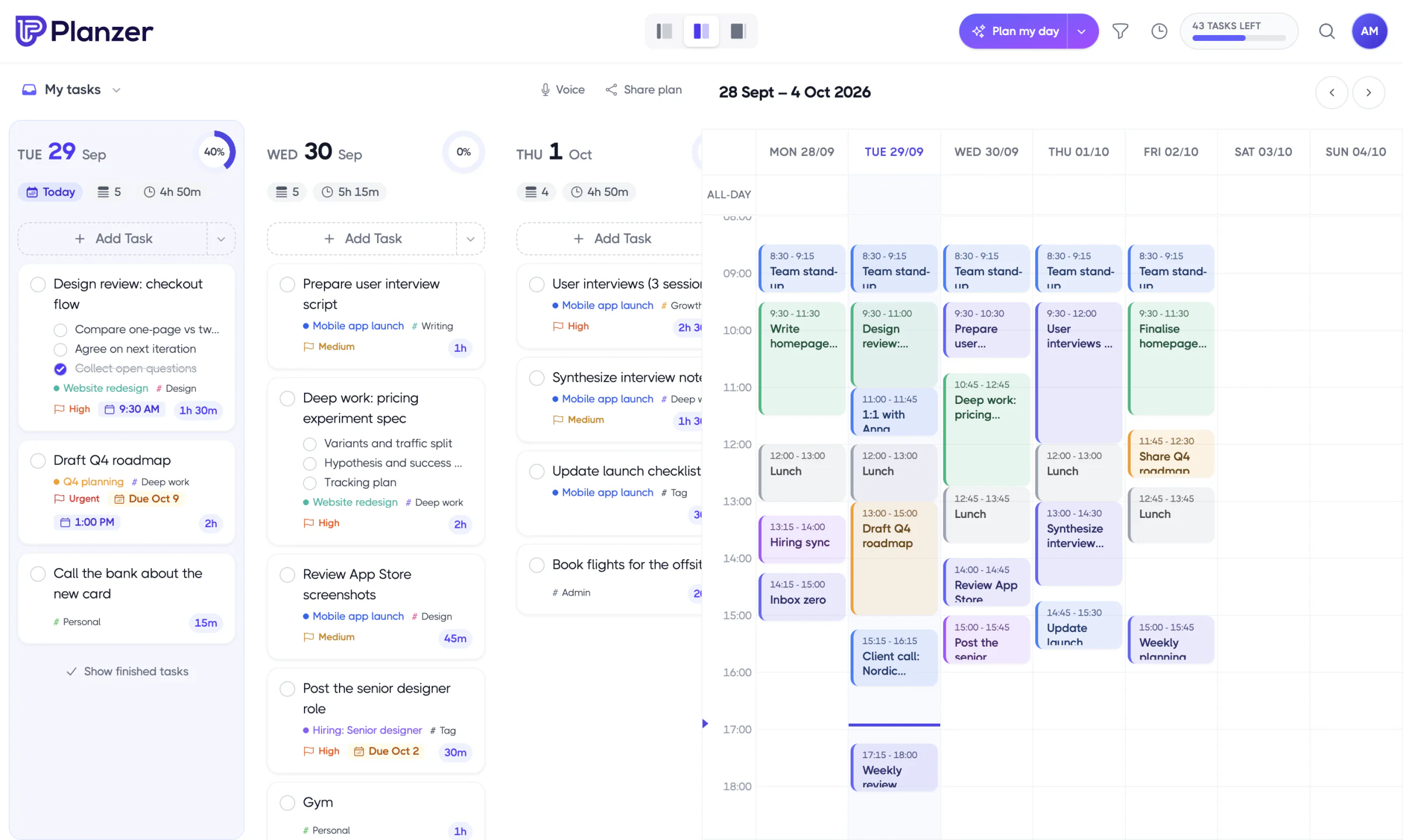
- Wind down the day. The shutdown ritual walks you through your wins, what got in the way and your energy from 1 to 5. You can also tag why tasks slipped, which covers the time and energy questions above without a blank page.
- See estimates vs actual. If you track time on tasks, productivity analytics shows estimated vs actual time and a “Why tasks slip” view built from your tags, so patterns show up on their own.
- Set up tomorrow. Unfinished tasks are ready for the next morning’s “Plan my day” ritual, which is part of Planzer’s daily planning flow.
The questions matter more than the tool. Use whatever you’ll actually open at 5 pm.
FAQ
How long should daily reflection take?
Two to five minutes is enough for most people. Pick four questions, write one line for each and stop. If something significant happened, take longer that day, but keep the default short so the habit sticks.
Should I write reflections down?
Yes, if you can. Writing makes your answers more specific, and it builds a record you can review at the end of the week. A notes app, a paper journal or the shutdown step in your planner all work. Thinking through the questions on your walk home is still better than nothing.
What’s a good end of day question for teams?
Keep it simple and safe to answer: “What’s one thing you finished today, and is anything blocking you tomorrow?” It surfaces progress and blockers without turning into a status meeting. Avoid questions about mood or energy in group settings unless your team has asked for them.
What are good end of day journal prompts if I’m short on time?
Use two: “What did I finish today?” and “What’s my first task tomorrow?” The first gives you a sense of progress, and the second gives you a clear starting point for the morning.