


You sat down at 9:00 to fix one bug. Then there was stand-up. Then a question in Slack. Then a PR to review, a production alert, and a “quick call” that took 40 minutes. It’s 16:00, and the bug is still open.
Most developers don’t have a productivity problem. They have a planning problem. Their work is scattered across GitHub, Linear or Jira, their calendar is shaped by other people, and their day gets decided one interruption at a time.
This guide gives you a simple daily planning routine built for how developers actually work — so you can protect your focus time and still be there for your team.
Why planning is harder for developers
Your work lives in too many places
Issues in GitHub, tickets in Jira, a sprint board in Linear, review requests in your inbox, and “can you take a look?” in Slack. When your work is spread across five tools, it’s hard to see what today actually looks like.
Deep work needs long, uninterrupted blocks
Paul Graham described this well in his essay Maker’s Schedule, Manager’s Schedule: managers work in one-hour slots, makers need half a day. A single meeting in the middle of the afternoon can break an entire block of focused work.
Interruptions are expensive
Research by Gloria Mark at UC Irvine found that it can take more than 20 minutes to get back to a task after an interruption. For work that requires holding a complex system in your head, the real cost is often higher.
Estimates are hard
“It’s a small fix” is the most dangerous sentence in software. Without comparing estimates to reality, the same tasks keep taking twice as long as planned — and your plans keep failing.
A daily planning routine for developers
1. Collect everything assigned to you (5 minutes)
Start by getting all your work in one place: issues assigned to you in GitHub, your tickets in Jira or Linear, review requests and anything you promised someone yesterday. Don’t plan yet — just collect.
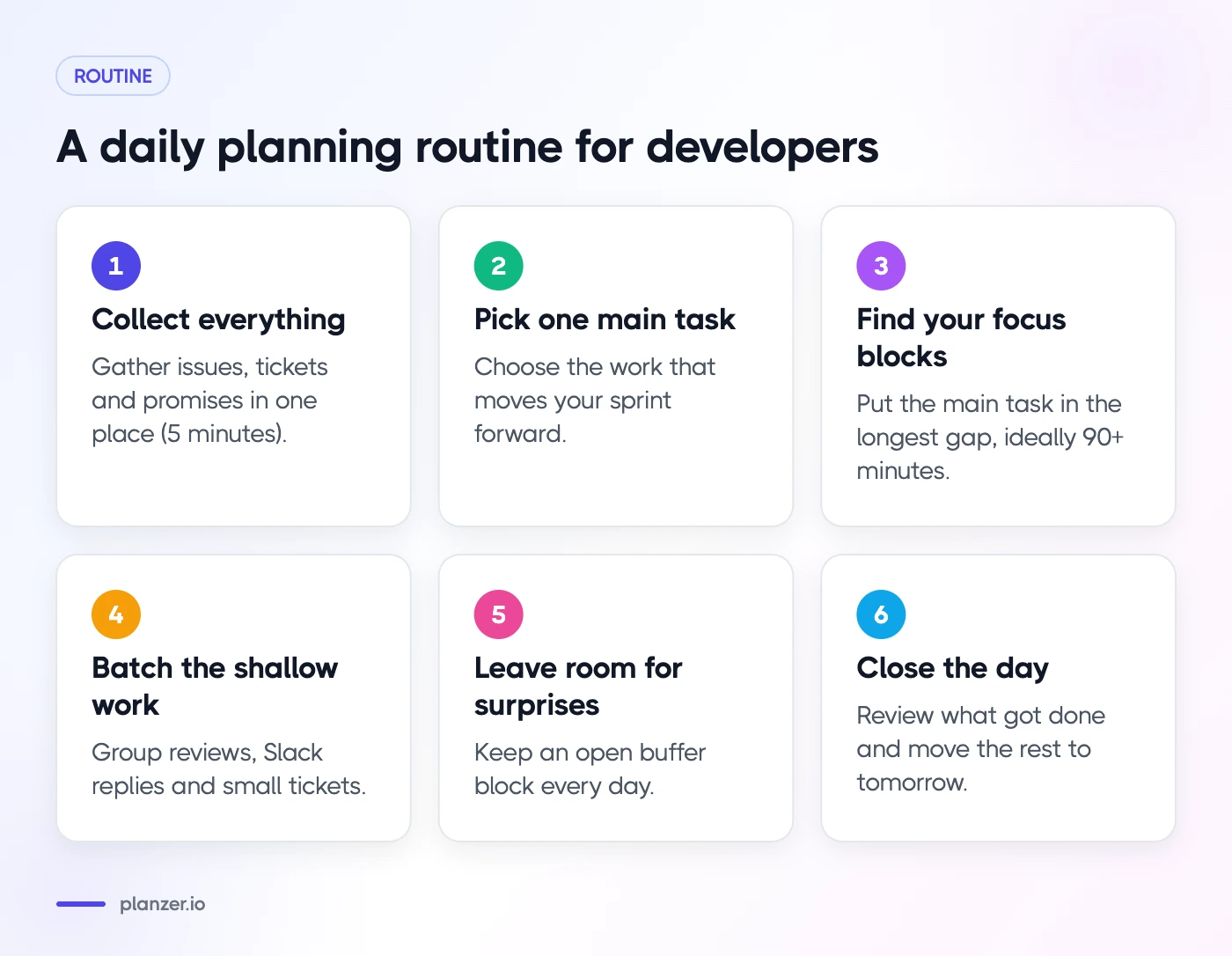
2. Pick one main task for the day
Choose the single most important piece of work — usually the thing that moves your sprint forward. If you only finish one thing today, it should be this. Then pick one or two smaller tasks as secondary goals.
3. Find your focus blocks
Look at your calendar and find the longest gaps between meetings. Put your main task into the best one, ideally at least 90 minutes long. If there’s no gap longer than an hour, that’s a sign to move a meeting or block focus time earlier in the week.
4. Batch the shallow work
Code reviews, Slack replies, emails and small tickets are important, but they don’t need your best hours. Batch them into one or two blocks — for example after stand-up and at the end of the day — so they don’t fragment your focus time.
5. Leave room for the unexpected
Production issues, urgent bugs and colleagues who need help will happen. Keep an open buffer block every day, so an interruption doesn’t wreck your whole plan.
6. Close the day
Before you log off, spend five minutes on a shutdown: what got done, what slipped, and why? Move unfinished work to tomorrow and note where you left off, so you can pick up quickly in the morning.
How to protect your focus time
- Block it in your calendar: a visible block is much harder to book over than an empty slot.
- Turn notifications off during focus blocks: set Slack to “do not disturb” and close your email.
- Tell your team: agree on how to reach you for real emergencies, so everything else can wait an hour.
- Capture interruptions, don’t act on them: when something comes up, write it down in one line and get back to the code.
- Use focus sessions: a timer running for 45–60 minutes makes it easier to ignore the urge to check messages. Read more in our guide to the Pomodoro Technique.
Plan around your sprint, not just your day
A good day starts with a good week. On Monday, look at what the sprint needs from you and roughly sketch which days you’ll spend on which work. Each morning, you only need to adjust the plan instead of starting from scratch.
At the end of the week, look back: which tasks took longer than expected, and why? Over time, this is what makes your estimates — and your sprint commitments — more reliable.
An example day
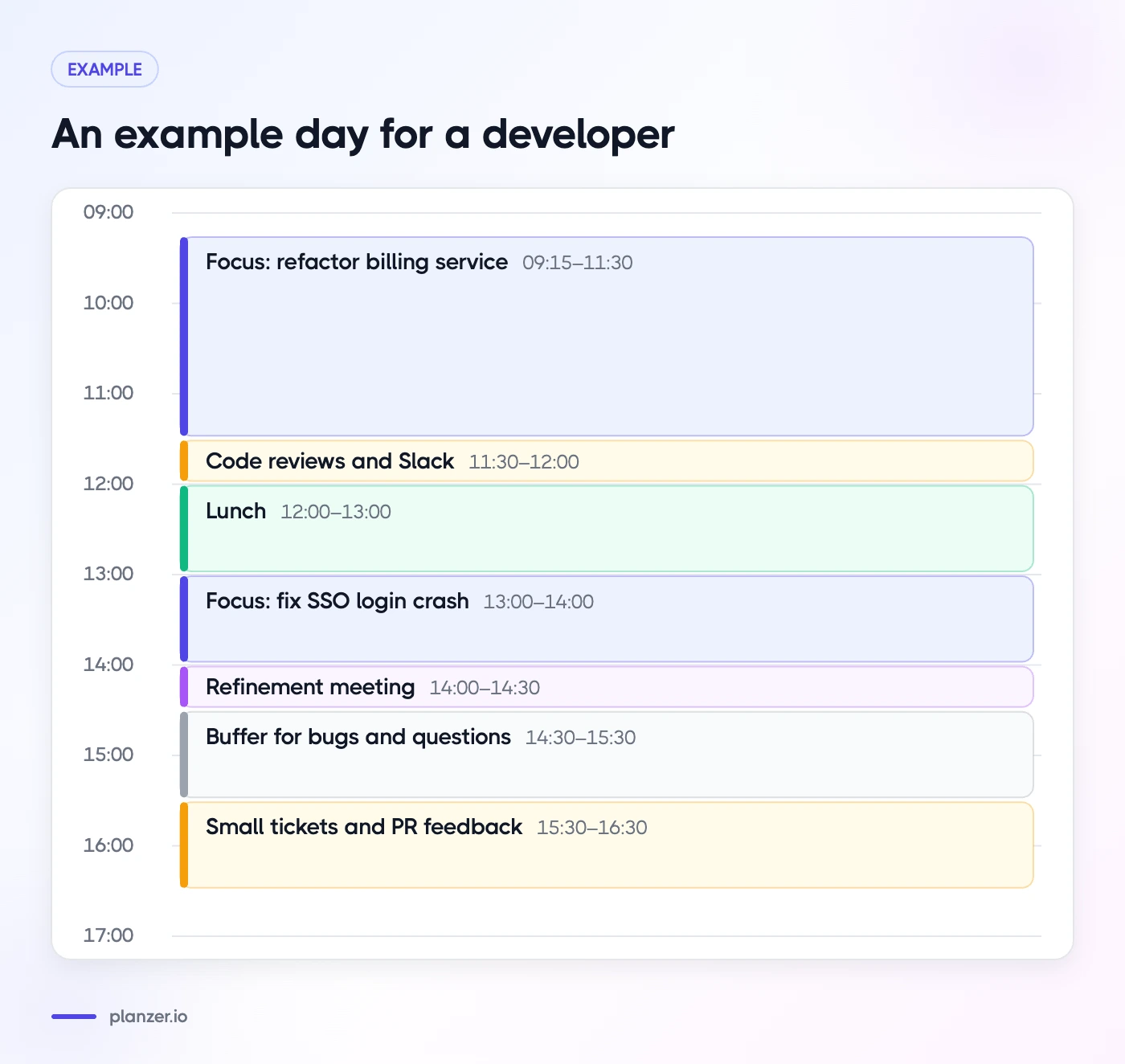
- 08:45–09:00 — Plan the day: collect issues, pick the main task
- 09:00–09:15 — Stand-up
- 09:15–11:30 — Focus block: refactor the billing service
- 11:30–12:00 — Code reviews and Slack
- 12:00–13:00 — Lunch
- 13:00–14:00 — Focus block: fix the SSO login crash
- 14:00–14:30 — Refinement meeting
- 14:30–15:30 — Buffer for bugs and questions
- 15:30–16:30 — Small tickets and PR feedback
- 16:30–16:45 — Shut down: review and plan tomorrow
Plan your day as a developer with Planzer.io
Planzer.io for developers brings the whole routine into one place:
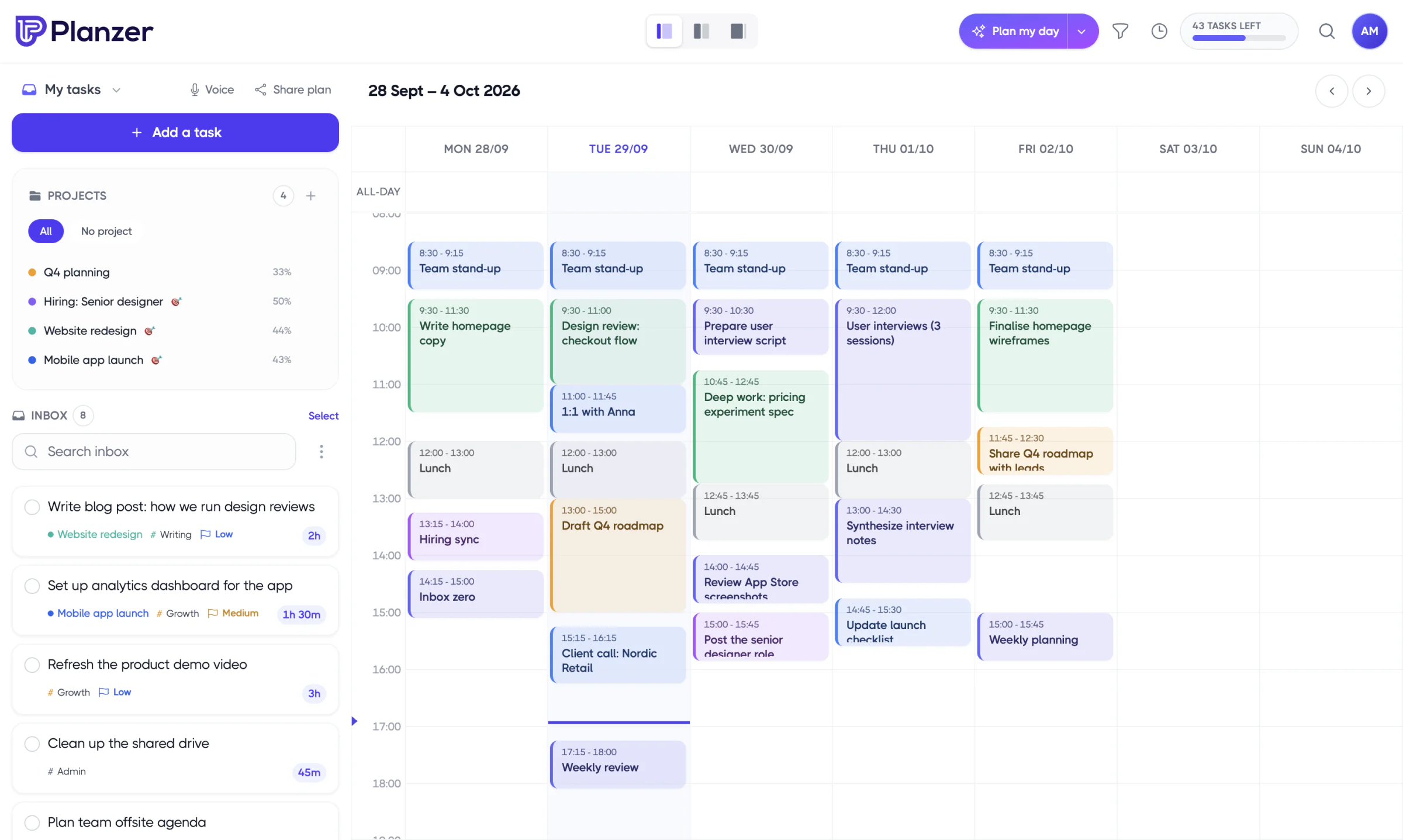
- Your issues in one list: connect GitHub, Linear and Jira, and the issues assigned to you show up automatically — across every repo, team and project.
- Plan it for me: let Planzer.io place your tasks in the gaps between your meetings, ordered by priority and deadline.
- Focus sessions: start a focus session with ⌘K, keep the timer in your menu bar, and press ⌘⌥T to start your next task from any app.
- Quick capture: add tasks with #tag, @project, ~30m and !high as you type, or just press V and say it.
- Estimated vs actual: see how long your tasks really take and plan the next sprint more realistically.
FAQ
How many hours of deep work can a developer do per day?
Most people can manage around three to four hours of truly focused work per day. Plan for that, and use the rest of the day for reviews, meetings and smaller tasks.
Should developers plan their day or their week?
Both. Plan the week around your sprint goals, and plan each day in detail in the morning. Read more in Should I Plan My Day Or My Week?
How do I handle interruptions from my team?
Agree on a “focus hours” convention with your team, batch questions into set times, and keep a buffer block for urgent issues. Most questions can wait an hour; very few can’t.
What’s the best time of day for deep work?
For most people it’s the morning, before meetings and messages build up. But the best time is the one you can protect consistently — pay attention to when you focus best and block that time.